Editor’s note: According to Market.us Scoop, the market for AI in DevOps is growing quickly. Experts say that by 2033, AI will be worth $24.9 billion in DevOps, which is a big jump from $2.9 billion in 2023. These numbers strongly suggest a fundamental shift from automation to autonomous intelligence. By 2026, AI doesn’t just make things more productive; it also changes the way systems work by predicting failures, healing themselves, and managing complex hybrid infrastructures with little help from humans. Hence, DevOps is moving beyond reacting to alerts to preventing them entirely through adaptive AI. If you are looking for effective solutions to scale your global business by adopting AI-driven DevOps, this article is your complete guide to navigate through major changes as well as strict regulations.
In 2026, AI-driven DevOps won’t just be an option; it will be the backbone of the FinTech, Healthcare, SaaS, and e-commerce industries. Companies that use AI in DevOps say that it makes it 30% to 50% faster to fix problems and 20% to 40% cheaper to build infrastructure. Furthermore, according to a report from Gartner, 80% of software companies are expected to use Internal Developer Platforms (IDPs) to make delivery more consistent and deal with the challenges of hybrid cloud.
Boosting Engineer Velocity: Transforming DevOps Experience with AI Tools
Today’s AI technology world no longer uses lines of code to measure developer productivity. That measurement is no longer useful. The use of AI tools by DevOps engineers has changed the meaning of productivity to “speed of value delivery.” It’s not about how much code you write, but how quickly you can ship safe, working features. Gartner’s study of DevEx shows that friction, whether it’s from slow builds, flaky tests, or too much information to process, is what really slows down engineering speed. AI tools are at the center of this problem. They act like smart copilots by giving real-time context, suggesting ways to improve things, and even predicting possible merge conflicts before they happen.
This change is important for keeping the best employees. Engineers don’t want to deal with configuration files; they want to solve intriguing problems. Companies that use AI in their DevOps processes say their employees are happier and less likely to burn out. AI integration reduces routine coding time by half, allowing engineers to concentrate on the creative aspects of software development.
When you work with Trustify Technology, our AI expert team helps you build these “Joyful Pipelines” using our AI Delivery Platform. The toolchain then supports the engineer automatically. We speed things up and make it easier for high-performing teams to work together by automating boring tasks. This lets us make software that is not only faster to build but also better and more stable.
Why ‘AI Tools for DevOps Engineers’ is a Strategic Necessity in 2026
In 2026, the main question is, “Can we afford not to use AI?” The return on investment for DevOps engineers who use AI tools is quick and easy to see. McKinsey says that companies that successfully integrate AI into their Software Development Life Cycle (SDLC) can cut development costs by 20–30% in just two years. This efficiency dividend comes from a number of places: predictive scaling cuts down on cloud waste, AI-driven quality gates cut down on costly rollbacks, and operational costs are much lower.
On the other hand, the cost of doing nothing is going up. Competitors who use AI tools for DevOps engineers are coming up with new ideas faster and doing business for less. They release new features every day, but legacy teams have trouble with weekly sprints. AI is strategically important for more than just cutting costs; it also helps businesses stay strong in the face of challenges. Businesses can now offer SLAs (Service Level Agreements) that were not possible before because AI can predict and stop outages.
That’s why our Trustify Technology AI experts often advise our clients to think of using AI as a strategy to keep their business operating, not as a project. Your business can stay ahead and thrive over time in a digital economy that is growing less stable by automating the “unknown unknowns” of IT operations.
Evaluation Criteria: Key Features of Enterprise-Grade AI DevOps Tools
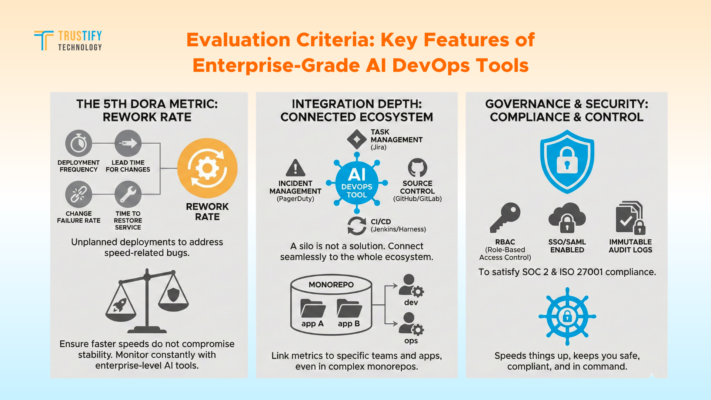
The four DORA metrics (i.e., Deployment Frequency, Lead Time for Changes, Change Failure Rate, and Time to Restore Service) have always been the best way to see how well DevOps is working. In the age of AI-generated code, a fifth DORA metric called “Rework Rate” has become important. The “Rework Rate” metric provides information on the number of unplanned deployments required to address speed-related bugs. DevOps engineers must constantly monitor this metric using enterprise-level AI tools to ensure that faster speeds do not compromise stability.
Integration depth is an evaluation criterion that cannot be changed. A silo is not a solution; it’s a tool that sits alone. To work well, AI tools need to connect easily to the whole ecosystem, which includes task management (Jira), source control (GitHub/GitLab), CI/CD (Jenkins/Harness), and incident management (PagerDuty). They need to be able to link metrics to certain teams and apps, even when there are a lot of them in a single monorepo.
Trustify Technology’s DevOps engineering team evaluates products depending on how well they can give us this whole picture. Governance and RBAC (Role-Based Access Control) are also very important to us. To satisfy compliance standards like SOC 2 and ISO 27001, tools must enable SSO/SAML and have audit logs that can’t be modified. A tool for businesses not only speeds things up, but it also keeps you safe, compliant, and in command.
From Automation to Autonomy: The Evolution of AI in DevOps
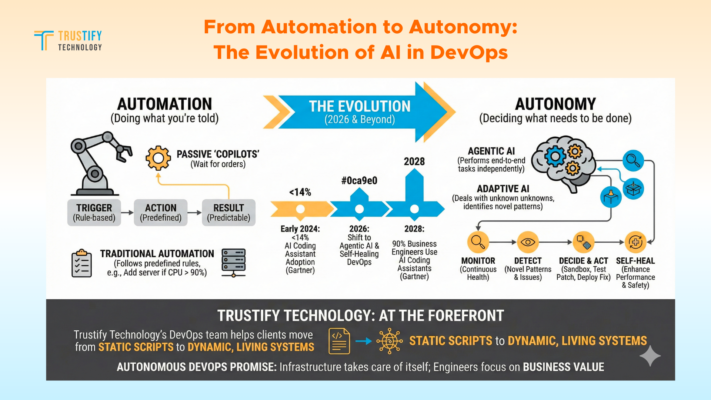
The next step in the development of DevOps is to go from “automation” (doing what you’re told) to “autonomy” (deciding what needs to be done). The industry will stop using passive “copilots” that wait for orders in 2026. Instead, it will use agentic AI, which can do all task steps independently. These agents don’t just find a security hole; they also make a sandbox, test a patch, and put the fix into use. We are currently in the “Self-Healing DevOps” era, where systems monitor their health and adjust their environments autonomously to enhance their performance and safety.
Adaptive AI makes this change possible. It helps systems deal with things they don’t know about. Traditional automation follows rules that are already in place, like “Add server if CPU > 90%.” Adaptive AI finds new patterns, like a memory leak that happens when a certain API call is made, and fixes them on its own without needing to write a rule. According to the Gartner® Magic Quadrant™ for AI Code Assistants, by 2028, as many as 90% of business engineers will use AI coding assistants. This is a huge increase from less than 14% in early 2024.
As a major player in the AI-driven software outsourcing market, Trustify Technology’s DevOps team is at the forefront of this change, helping clients move their infrastructure from static scripts to dynamic, living systems. This is what autonomous DevOps promises: infrastructure that takes care of itself so that engineers can focus on adding value to the business.
With our 20+ years of experience in software product development, we truly understand that in strict fields like finance and healthcare, strict compliance is what builds trust, which is the currency of the digital economy. The EU and US rules are so complicated that we need a new kind of AI tool for strict domains that puts transparency, explainability, and auditability first. Ultimately, AI governance is moving from lofty goals to real-world enforcement. Our DevOps engineers now need to implement “operational governance,” ensuring that the toolchain itself enforces the rules. This means adding tools that can automatically create a “Software Bill of Materials” (SBOM) for each release. This SBOM should list not only open-source dependencies but also where AI models came from and the datasets used to train them.
Our Trustify Technology DevOps experts know a lot about these kinds of rules and regulations. That’s why we’re fully committed to helping your business’s internal teams build this “Trust Infrastructure” by choosing and integrating the best DevSecOps and governance tools. We focus on solutions that support Role-Based Access Control (RBAC) and immutable audit logging. This makes sure that every change to the system can be tracked and is allowed.
For instance, the EU AI Act says that AI systems that are high-risk need to have systems in place to manage risks all the time. We use AI to automate this risk assessment by scanning pipelines for possible compliance drifts and making compliance reports for regulators in real time. By making these features a part of the DevOps workflow, we give businesses the confidence to come up with new ideas because they know their infrastructure can handle the scrutiny of the world’s strictest regulators.
Automating GDPR & CCPA Compliance in Fintech & Banking
Fintech and banking companies that don’t follow the rules are in a lot of trouble. If you don’t handle data correctly, the California Consumer Privacy Act (CCPA) and the General Data Protection Regulation (GDPR) will punish you severely. However, the rapid pace of banking these days necessitates timely software updates. Policy-as-Code (PaC) is the answer. It will help you follow the GDPR and CCPA. By defining regulatory requirements as code, banks can ensure compliance checks and enforcement with every commit. This procedure means that the rules and the application code can run at the same time. AI tools are very useful for DevOps engineers because they use natural language processing (NLP) to turn legal texts that are challenging to read into technical policies that CI/CD pipelines can understand and follow.
This automation also applies to data privacy. Our DevOps engineering team at Trustify Technology adds advanced tools for data masking and synthetic data generation to the DevOps pipeline. We strongly believe that protecting private information is essential. Consequently, our solutions always make sure that developers who work on banking apps never see real customer data. Instead, AI-powered tools make fake datasets that look real and follow privacy rules for testing and development.
It is also possible to initiate automated “Right to be Forgotten” workflows across various systems. It makes sure that when a customer asks for data to be deleted, it happens right away across all databases and backups. This automation turns compliance from a manual bottleneck into a smooth, invisible part of the banking infrastructure. The procedure lets big banks come up with new ideas as quickly as a startup while keeping their security strong.
Securing Healthcare & Medtech Pipelines with DevSecOps
Cybercriminals have a huge target now that health records are digital. To protect Healthcare and Medtech pipelines, data privacy must be built into the infrastructure code. These days, AI governance requires strict rules about handling patient data. In this kind of regulatory environment, our Trustify Technology AI DevOps team will work with your business operations teams to set up self-driving security agents in your DevSecOps pipelines. These agents work like digital guards, always looking for security holes in container images and infrastructure setups that could put PHI (Protected Health Information) at risk, such as open ports or unencrypted storage.
Our method goes beyond passive scanning to active defense. If a security agent sees a container trying to connect to an external IP without permission, it can automatically isolate the container and cut off the connection to stop data from being stolen. Medtech IoT devices require this “Active Response” feature due to their frequent operation in uncontrollable environments, such as patients’ homes. By adding these self-defense features to the DevOps pipeline, we make sure that security goes with the app and stays with it for the whole life of the device. In other words, as Healthcare and Medtech providers, we will help your business by taking advantage of the benefits of connected health while keeping the highest standards for data stewardship.
Modernizing Public Sector Infrastructure with the Right AI Tools
The public sector is in charge of important physical infrastructure, like transportation networks, power grids, and water systems, that are becoming more and more software-defined. We need to modernize infrastructure, which also includes IT systems. We need to move toward predictive operations in this infrastructure. In other words, at Trustify Technology, our team of AI DevOps experts can fully apply adaptive AI to the public sector by using AI monitoring tools that look at data from IoT sensors all over the city.
For instance, in a smart city project, AI tools can tell when traffic lights or water pumps are going to break down weeks before they do, so maintenance crews can fix them before they happen. The government agency’s DevOps platform has this “predictive maintenance” feature built in, which means that alerts about physical infrastructure are handled with the same urgency and workflow as software incidents. We help public sector leaders build strong, “always-on” cities by choosing AI tools that connect IT (Information Technology) and OT (Operational Technology). Our proactive approach cuts down on service interruptions, lowers maintenance costs, and ultimately makes people’s lives better. Such a practical use case shows how AI-driven modernization can really benefit the public.
Accelerating “High-Velocity” Industries: Travel, IoT, and Logistics
In fields like Travel Tech, Smart Home IoT, and Logistics, the margin for error is measured in milliseconds and millimeters. These “high-velocity” industries generate vast amounts of data that must be processed simultaneously, require real-time responses to user needs, and involve complex, distributed infrastructure. DevOps methods that rely on manual scripting and reactive monitoring are just too slow to keep up with all of this change. If you want your business to do well, you should switch to AI-powered operations that can predict spikes, find the best routes, and fix firmware on their own. AI-powered DevOps automation lets systems make thousands of small decisions every second, like scaling cloud resources during a flash sale or changing the route of a fleet of delivery drones to avoid a storm, without needing any help from people.
Our Trustify Technology’s AI engineer team will help your business go beyond simple automation to true operational resilience by adding AI tools for DevOps engineers to your business’s core infrastructure. We could use machine learning to predict when bookings will spike and set aside server space for an international travel platform. For an IoT maker, this means putting edge-AI models on devices that can find and fix connectivity problems in real time. This change in strategy speeds up the time it takes to get to market and makes sure that the underlying technology can scale easily. This turns technical infrastructure from a bottleneck into a business catalyst that boosts sales and customer satisfaction.
Real-Time Scaling for Travel Tech: Predictive Capacity Planning
For travel tech companies, the cloud bill is usually the second biggest expense after payroll. When you over-provision to ensure uptime, you waste millions of dollars. When you under-provision, you risk outages during peak booking times. Predictive capacity planning solves this economic problem by making sure that spending on infrastructure matches user demand perfectly. AI algorithms dynamically adjust the resource pool, eliminating the need to maintain thousands of idle servers for contingency. They spin down capacity during lulls and up it exactly when needed.
Trustify Technology adds these AI-powered financial operations (FinOps) to our DevOps pipeline. Our solutions continuously monitor the performance and cost metrics of applications, making real-time decisions about resource allocation. If an AI agent sees that a certain microservice isn’t being used enough, it can automatically combine workloads or switch to cheaper spot instances. This level of detailed, automated control transforms cloud infrastructure from a fixed cost to a versatile utility. It lets travel companies work like a startup with a lot of efficiency and like a big business with a lot of scalability, which helps them make money in an industry with low margins and high volume.
Smart Home IoT: Reducing Latency with Edge-AI Deployment
Latency is a big problem for user trust in the Smart Home ecosystem. A smart lock that takes a long time to unlock or a security camera that takes three seconds to recognize a face makes things hard to use. Moving intelligence from the centralized cloud to the device itself is one way to lower this latency. The technique is called Edge-AI Deployment. We can directly install lightweight AI models on IoT gateways and sensors, allowing devices to process data locally and make instantaneous decisions, thereby eliminating the need for a round trip to a data center.
Our Trustify Technology’s AI DevOps team aims to make these edge deployments work better. We use AI tools to help DevOps engineers compress and compile machine learning models so they can run well on hardware with limited resources. Our pipelines handle the “Over-the-Air” (OTA) updates for these models, which means that millions of devices get the newest security patches and feature improvements at the same time. This method not only lowers latency, but it also lowers bandwidth costs and increases privacy by processing voice and video data on the device itself. By letting devices think and act at the edge, we help manufacturers give modern consumers the quick, seamless response they want.
Logistics Optimization: AI-Driven Route & Fleet Management Pipelines
When a truck breaks down, it not only causes problems, but it also breaks a customer’s trust. AI-powered fleet management does more than just plan routes; it also includes predictive maintenance to deal with situations like these. AI models can predict mechanical problems weeks in advance by analyzing telemetry data from vehicle engines, including fuel consumption, temperature, and vibration. Predictive analytics do show important values, which makes running a business less risky. These insights help logistics companies plan maintenance for when their trucks are not in use, so they don’t break down while driving.
When you work with Trustify Technology, our AI DevOps experts will help your business team add these predictive features to the operational dashboard. We build data pipelines that take in sensor data from thousands of vehicles, use anomaly detection models to process it, and then automatically create maintenance tickets in the ERP system. This full automation makes sure that the fleet works at its best with as little human help as possible. Also, by comparing maintenance data with route history, the system can find out if certain routes or driving habits are making things wear out faster. Our broad view allows us to make data-driven decisions that extend the life of vehicles, cut down on capital costs, and keep the logistics network running smoothly.
FAQ: Operationalizing Your AI DevOps Strategy
What are essential AI tools for DevOps engineers?
The DevOps landscape has changed from simple automation to include agentic AI and AIOps by 2026. These tools not only suggest codes or find bugs, but they also plan, carry out, and fix complicated workflows. There are four main groups of important tools: AI-Assisted Coding, Infrastructure and CI/CD Orchestration, DevSecOps/Security, and Observability/AIOps.
|
Tool
|
Category
|
Key AI Features
|
Pricing Model
|
Complexity
|
Key Risks
|
|---|---|---|---|---|---|
|
GitHub Copilot
|
Code Assistant
|
Agent HQ for orchestrating multiple agents; context-aware code generation; automated unit testing.
|
Subscription (Individual/Business).
|
Low (IDE Extension)
|
Insecure Code: May suggest vulnerabilities requiring review.
|
|
Spacelift
|
Infrastructure Orchestration
|
Saturnhead AI analyzes runner logs to explain failures; Intent allows natural language infrastructure provisioning.
|
Free tier available; Paid subscription.
|
Medium/High (Requires IaC knowledge)
|
Misconfiguration: AI-generated infrastructure must pass policy guardrails.
|
|
Aikido Security
|
DevSecOps Platform
|
AI AutoFix generates pull requests to patch vulnerabilities; AI triage reduces 85% of alert noise,.
|
Free tier (2 users); Flat rate paid plans.
|
Low (Plug-and-play)
|
False Negatives: Reliance on auto-triage requires trust in model accuracy.
|
|
Snyk
|
DevSecOps
|
DeepCode AI for vulnerability scanning in code/containers; automated fix suggestions; risk prioritization.
|
Freemium; Enterprise pricing.
|
Medium
|
Over-reliance: Developers may accept fixes without understanding security implications.
|
|
Datadog
|
Observability / AIOps
|
Watchdog for unsupervised anomaly detection; Bits AI agents for incident investigation and response.
|
Usage-based (can scale high).
|
Medium
|
Cost Spiraling: High data ingestion costs if not managed.
|
|
Dynatrace
|
Observability / AIOps
|
Davis AI uses causal AI (deterministic) for root-cause analysis rather than just correlation.
|
Usage-based / Modular.
|
High (Full stack)
|
Complexity: Initial full-stack setup can be resource-intensive.
|
|
PagerDuty
|
Incident Response
|
Event Intelligence groups alerts to reduce noise; AI-drafted postmortems and automation triggers.
|
Free tier; Tiered subscription.
|
Low/Medium
|
Context Loss: Aggressive noise reduction might mask subtle signals.
|
|
Sysdig
|
Cloud Security
|
Sysdig Sage AI analyst for threat investigation and Cloud Security Posture Management (CSPM).
|
Commercial (Enterprise).
|
Medium/High
|
Operational Overhead: Tuning runtime policies to avoid blocking legitimate traffic.
|
|
Amazon Q Developer
|
General Assistant
|
Generates AWS infrastructure (IaC); diagnoses console errors; agentic coding capabilities.
|
Usage-based (AWS account tied).
|
Medium (AWS specific)
|
Vendor Lock-in: Highly optimized for AWS, potentially limiting multi-cloud use.
|
How does Trustify Technology integrate AI in continuous integration and delivery pipelines?
We take advantage of the AI Delivery Platform so AI-driven DevOps platforms can learn from incidents and prevent future occurrences. When coupled with continuous integration/continuous delivery (CI/CD) pipelines, it automates the entire journey from code commit to production deployment.
How can Trustify Technology ensure quality and security for AI DevOps?
Our teams ensure the quality and accuracy of our AI-driven DevOps solutions through rigorous testing, validation, and continuous monitoring. Additionally, we leverage advanced techniques to train our models. Our team also regularly updates them with new data to maintain high performance and reliability.