
Every bank we speak to wants AI agents on its 2027 roadmap. Very few can yet answer the first question their risk team will ask:
“What exactly is this agent allowed to do with our money?”
That question will follow agentic AI around Singapore FinTech Festival 2026, which runs from 18 to 20 November. Technology is one of the five forces on this year’s agenda, and sessions such as “Moving Beyond Pilots in Agentic AI: Pitfalls, Scaling and the Commercial Case” go straight at the gap between a good demo and a system a bank can trust.
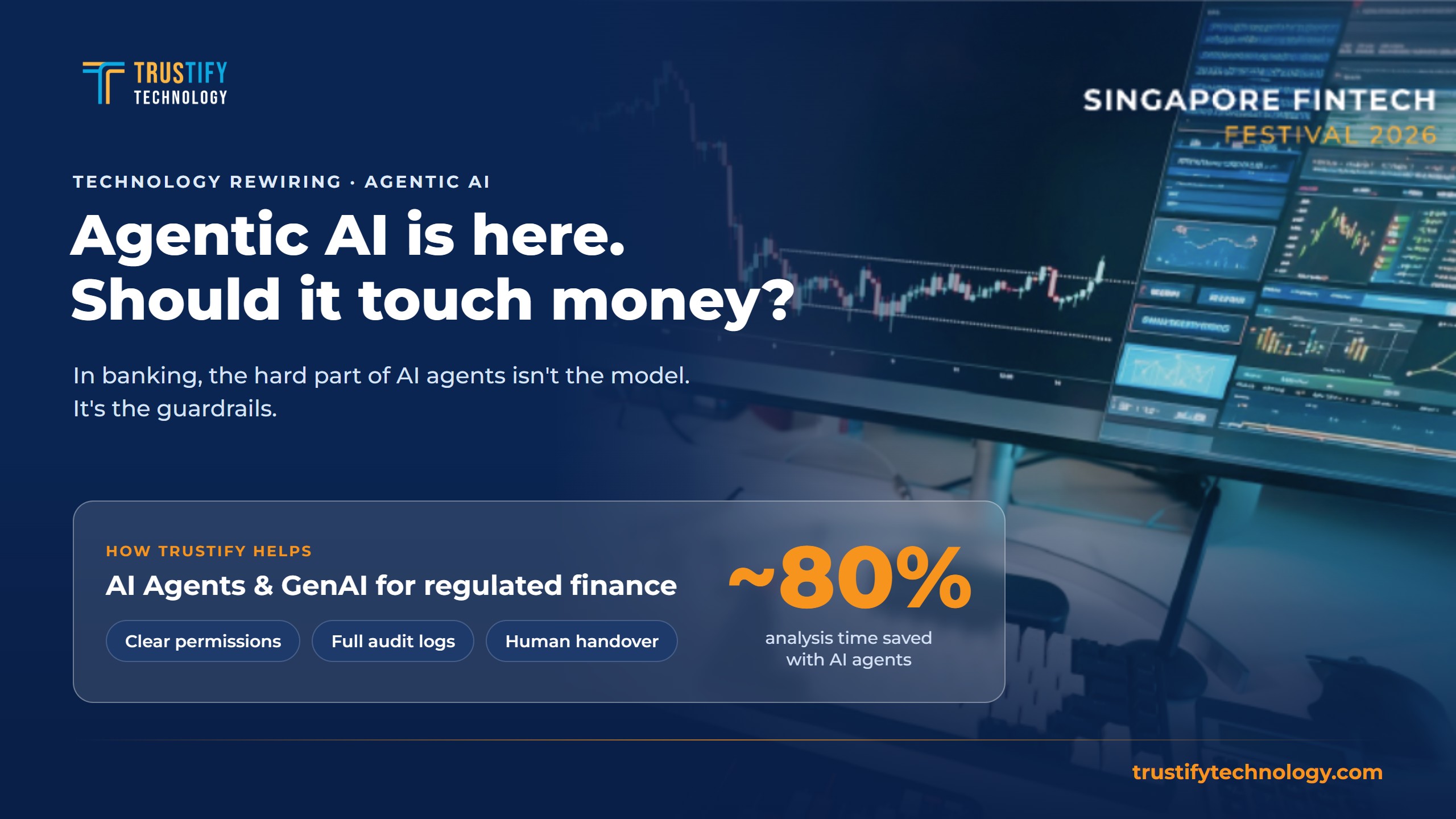
Our view, from building AI agents for regulated finance, is simple. In banking, the hard part of AI agents isn’t the model. It’s the guardrails. And the advantage goes to whoever ships the guardrails first.
Why Agents Change the Risk Conversation
A chatbot answers questions. An agent takes actions. It reads documents, calls internal systems, makes recommendations and, if you let it, moves money.
That is where the value is. It is also where an occasional model error stops being an awkward answer and becomes a loss, a breach or a finding from the regulator.
So the useful question is not “Is the model good enough?” It is three narrower ones: what can the agent do on its own, how do we see what it did, and when does a person take over?
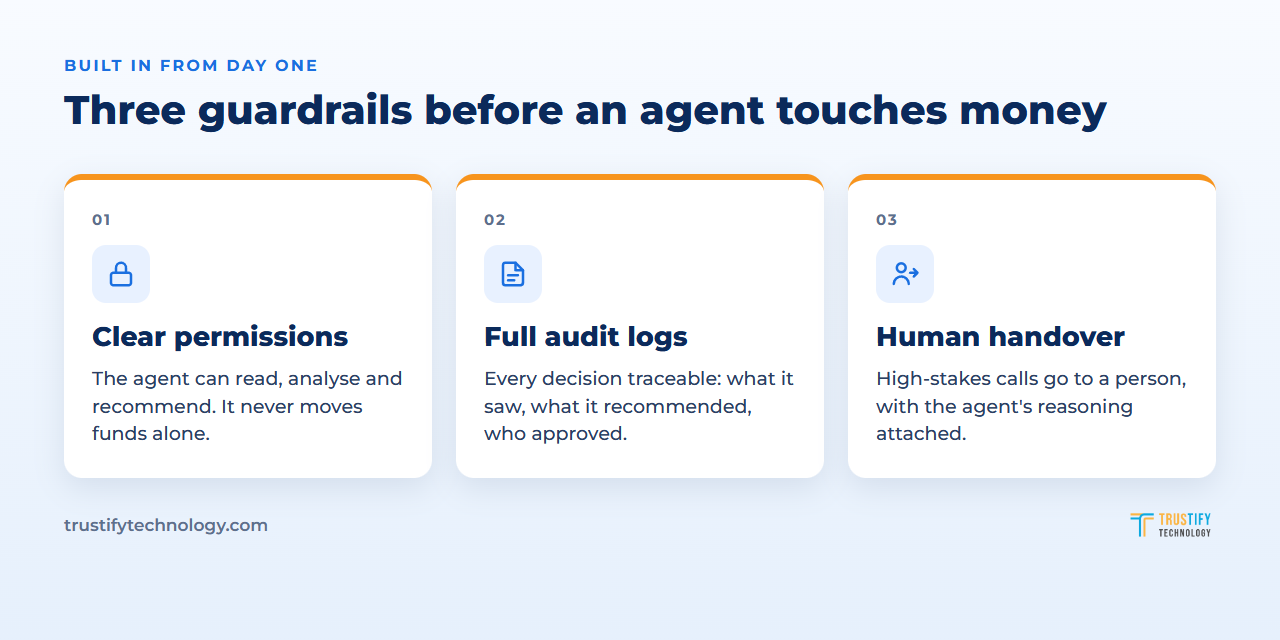
Three Guardrails to Build In From Day One
1. Clear Permissions
The agent can read, analyse and recommend. It never moves funds on its own. Set permissions per action rather than per system: reading a statement and changing a credit limit are different rights, even inside the same platform. Anything that changes a balance, a limit or a customer record goes through an approval step.
2. Full Audit Logs
Every decision should be traceable for the regulator: what the agent saw, which model output or rule it relied on, what it recommended and who approved it. If someone asks why an application was flagged six months ago, the answer should take minutes, not a forensic project.
3. Human Handover, by Design
High-stakes calls go to a person. Agree the thresholds up front, whether that is an amount, a risk score or a confidence level, and make the agent stop and hand over when it crosses one. Send its reasoning with the handover, so the reviewer is not starting from zero.
None of this slows a good team down. It is what lets a risk committee say yes.
What This Looks Like in Practice
Two examples from our own work:
- Lending decisions that stay with people. For a clean-energy company in Vietnam that finances solar systems through instalment plans, we built an AI Credit Agent that reads credit reports and financial statements and flags whether a borrower profile looks good or risky. A second agent, AI Contract Check, detects any difference between a signed contract and the original. The agents flag; the credit team decides.
- Faster analysis without losing control. For a large private equity firm in the UK, we built an AI portfolio intelligence platform that pulls company data from hundreds of sources and turns it into investment signals. It cut analyst time by around 80%, on a cloud deployment with data security and access controls built in.
In both cases, the model was the easy part. The design work went into deciding what the agent may do, what it must log and where it must stop.
Five Questions to Ask Before an Agent Touches Money
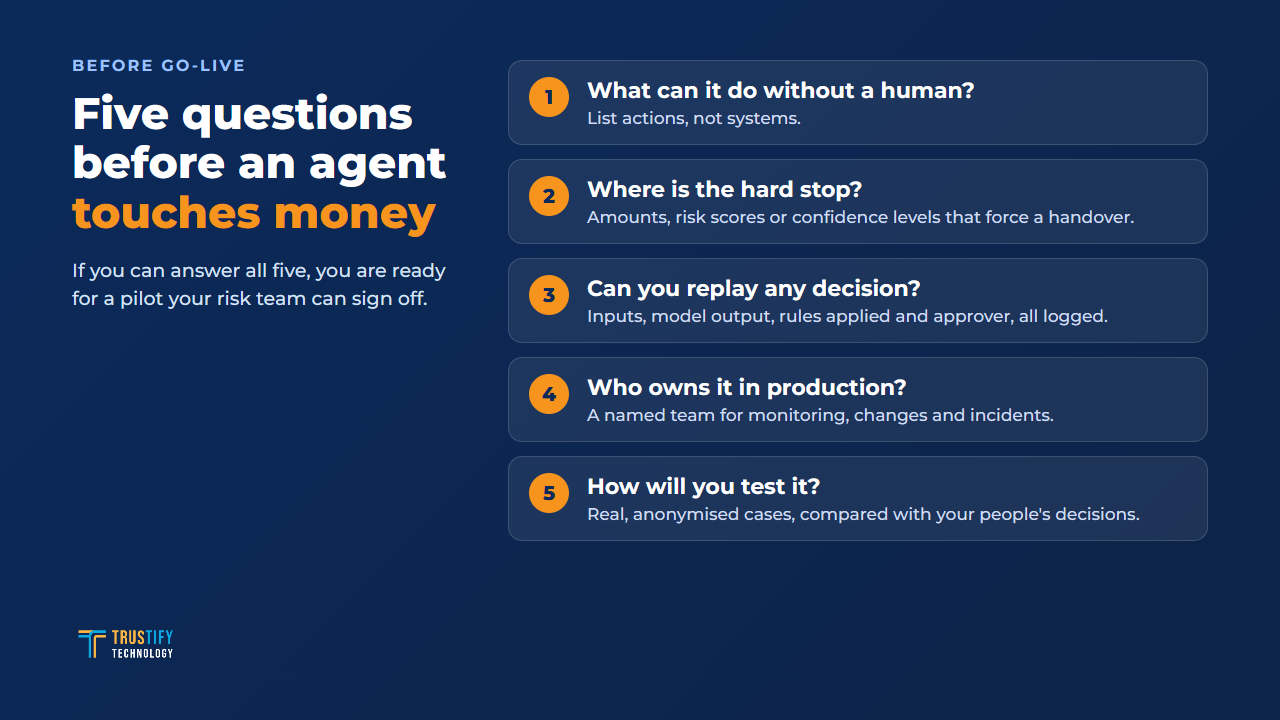
- What can the agent do without a human? List actions, not systems.
- Where is the hard stop? Name the amounts, risk scores or confidence levels that force a handover.
- Can you replay any decision? Inputs, model output, rules applied and approver, all logged and kept.
- Who owns the agent in production? A named team for monitoring, changes and incidents.
- How will you test it before go-live? Run it on real, anonymised cases and compare it with the decisions your people actually made.
If you can answer all five, you are ready for a pilot your risk team can sign off. If you can’t, that is the first piece of work, not the last.
Meet Us at SFF 2026
Steve Nguyen, our CGO, will be at Singapore EXPO from 18 to 20 November with the Trustify team. If agentic AI is on your 2027 roadmap, we would be glad to compare notes on what is working, and what isn’t.
Not going to Singapore? Book a call with our team.
Frequently Asked Questions
What is agentic AI in banking?
Agentic AI refers to AI systems that take actions towards a goal, not just answer questions. In banking, that might mean reviewing a credit file, drafting a recommendation or preparing a payment for approval.
Should an AI agent ever move money on its own?
In our view, not at the start. Let agents read, analyse and recommend, and keep money movement behind an approval step until you have the audit trail and track record to justify more autonomy.
Where should a bank start with AI agents?
Start with a narrow, high-volume task where a person already checks the output, such as document checks or credit pre-screening. That gives you a baseline to measure against and a natural point for human handover.